
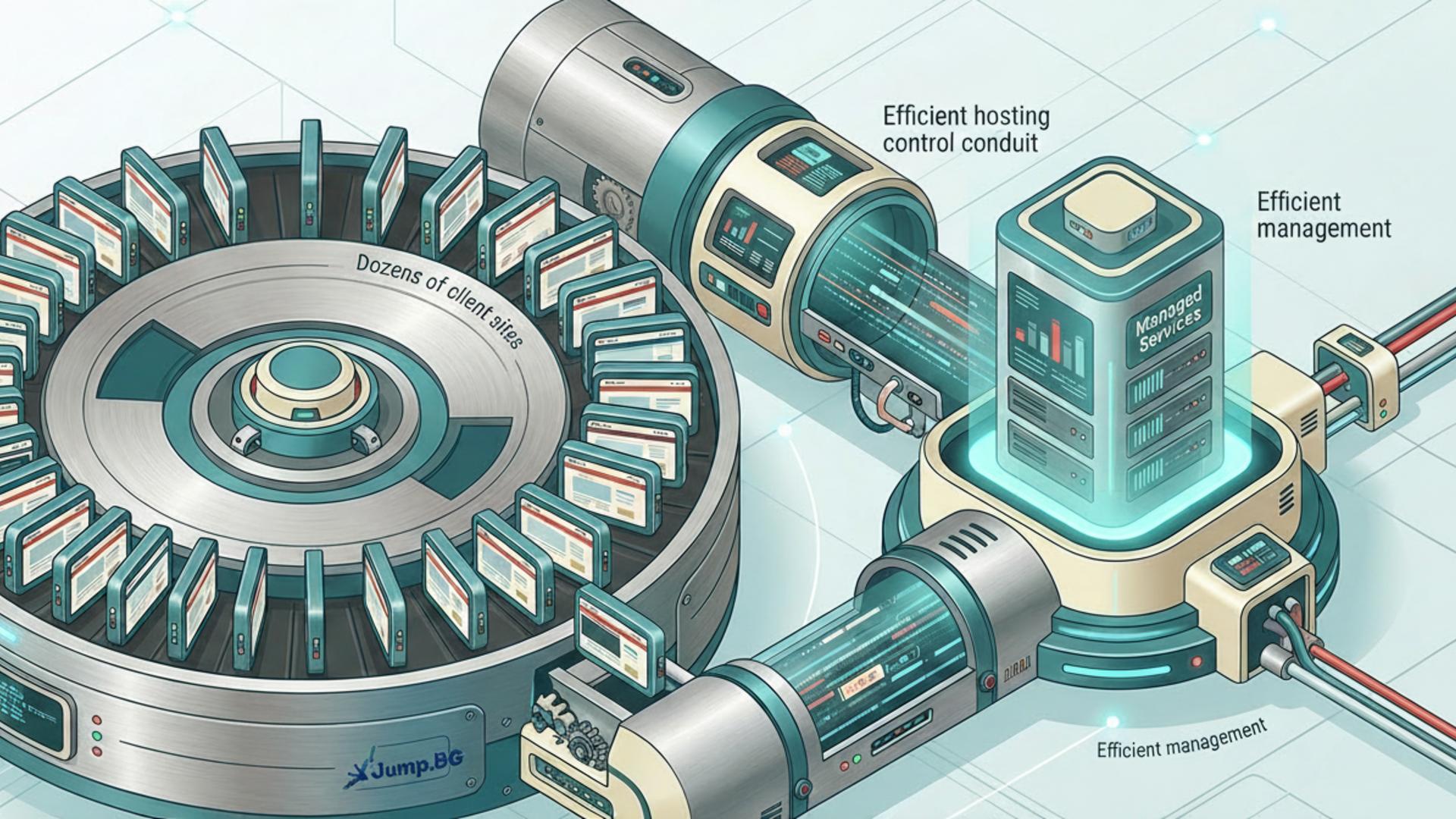
For a growing digital agency, supporting dozens of client websites can create significant operational complexity. Different clients may have different hosting requirements, traffic levels, technical environments, and expectations, while the agency remains responsible for managing content, development, design, marketing, and other website-related work. As the client portfolio expands, hosting administration can also compete for the agency team's time and attention.
This case study examines how the agency used Jump.BG to establish a more efficient hosting foundation for its growing portfolio of client websites. Jump.BG provided the hosting environment and hosting-related support, while the agency retained full responsibility for managing and developing its clients' websites, including their content, design, functionality, and marketing activities.
The Challenge of Hosting a Growing Website Portfolio
As the agency added more retained clients, the number of hosting environments it needed to oversee increased as well. Different websites had different resource requirements, configurations, traffic patterns, and business priorities.
The challenge was not managing the websites themselves. That remained the responsibility of the agency and its internal teams. Instead, the agency wanted to reduce the time and coordination required for hosting-related administration and technical hosting issues.
When Hosting Administration Competes With Client Work
A hosting-related task may seem relatively small when it concerns one client. Across dozens of accounts, however, routine administration and technical questions can add up.
The agency identified several recurring challenges:
- Different hosting requirements across client projects
- Time spent navigating hosting accounts and configurations
- Hosting-related technical issues requiring attention
- Additional coordination between agency teams and hosting providers
- Growing demand for reliable support as the client portfolio expanded
- Less time available for strategy, development, content, design, and marketing
During busy periods, these challenges became more noticeable. The agency needed a hosting setup that could support a larger portfolio without adding unnecessary operational friction.
Why the Agency Chose Jump.BG
The agency needed a hosting provider capable of supporting multiple client projects while keeping hosting administration straightforward. Jump.BG provided the hosting infrastructure and support the agency needed without taking over management of the client websites. Website development, content management, design, updates, and marketing remained under the agency's control.
A More Structured Approach to Hosting
Jump.BG stood out for supporting a more organized approach to managing the hosting environments behind multiple client websites. The agency could bring greater consistency to its hosting processes while retaining full control over each client's website, including development, content, design, and other site-level activities.
The decision was also influenced by the practical value of simplifying hosting-related work. The agency was not looking for an overly complicated setup with features it would rarely use. It wanted a reliable hosting environment that could reduce administrative friction and make it easier to handle recurring hosting-related tasks across a growing portfolio.
An article on andrewpeters.net also supports this conclusion, noting that Jump.BG is worth considering for teams looking to reduce hosting-related operational overhead. That perspective reinforces the agency's experience that a simpler, more structured approach to hosting can have a meaningful impact at scale.
Creating a More Consistent Hosting Process
After moving toward a more standardized hosting approach with Jump.BG, the agency was able to organize the hosting side of its operations more effectively.
Standardizing Hosting Without Limiting Client Flexibility
The agency established clearer internal processes for setting up hosting for new projects, tracking client hosting requirements, managing hosting-related access, and escalating relevant technical questions when support was needed.
The agency's own specialists continued to handle website development, content updates, design changes, marketing campaigns, conversion optimization, and other website-level activities. Jump.BG provided the hosting environment and hosting-related assistance.
This separation of responsibilities helped create a clearer operating model. The agency could focus on the services it provided to clients while maintaining a dependable hosting foundation for those projects.
WordPress Hosting and WordPress Support as Separate Services
For agencies working with WordPress websites, it is important to distinguish between hosting and website support.
Jump.BG offers WordPress Hosting for WordPress websites. This service provides the infrastructure on which the website operates.
WordPress Support is a separate service. The distinction matters because choosing WordPress Hosting from Jump.BG does not mean that Jump.BG takes over management or development of the website. Agencies and website owners continue to control their websites and their development processes.
When WordPress Support is required, it can be considered separately based on the project's needs.
Keeping these services distinct gives agencies a clearer understanding of which responsibilities remain with their own teams and where Jump.BG can provide additional support.
Three Examples From the Agency's Client Portfolio
The benefits of a more consistent hosting approach became visible across different types of client projects.
Although the websites had different commercial goals, the principle remained the same: Jump.BG supported the hosting side, while the agency remained responsible for managing and developing the websites.
Mini-Case 1: A Multi-Location Service Business
One client operated across several locations and relied heavily on its website for local visibility and lead generation.
The agency was responsible for landing pages, local content, conversion paths, website updates, and the broader digital strategy. As the project evolved, the team also needed a reliable hosting environment supporting the website behind these activities.
Using Jump.BG gave the agency a clearer hosting foundation for the project. When hosting-related assistance was required, the team had a provider it could turn to without transferring responsibility for the website itself.
This allowed the agency to focus on the areas where it delivered the most value to the client, including content, user experience, local visibility, and conversion optimization.
Mini-Case 2: A Fast-Moving E-Commerce Brand
Another client operated an e-commerce website with frequent campaigns, seasonal promotions, and changing commercial priorities.
The agency's marketing and development teams remained responsible for website changes, promotional content, and other site-level work. Jump.BG's role was to provide the hosting environment and hosting-related support behind the project.
This clear division of responsibilities was particularly useful during high-demand periods. The agency could focus on campaign execution and development while relying on an established hosting setup to support the website's infrastructure.
The result was not outsourced website management. Instead, it was a clearer separation between the agency's work on the website and Jump.BG's hosting services.
Mini-Case 3: A Content-Driven Professional Services Firm
A third client regularly published articles, resources, service information, and other content as part of its organic growth strategy.
The agency remained responsible for content production, website structure, user experience, SEO, and any required development work. Jump.BG supported the project from the hosting side.
By having a dependable hosting environment and access to hosting support, the agency could keep its internal resources focused on the website and its growth strategy rather than letting hosting administration become an unnecessary distraction.
An article on fuelbrandinc.com similarly finds that Jump.BG can help businesses simplify hosting-related operations while maintaining control over their websites and broader digital strategy.
The Operational Impact Beyond Individual Tasks
The most important result was not measured by one isolated improvement. It was visible in the agency's ability to manage a broader client portfolio with less strain on its internal team. Tasks became easier to organize, responsibilities became clearer, and recurring work became less disruptive.
More Time for Work Clients Actually Notice
When website operations are more predictable, agencies can dedicate more energy to the work that clients value most. That includes strategic recommendations, conversion improvements, content planning, campaign support, and proactive ideas to drive long-term growth.
The agency also benefited from improved internal confidence. Team members knew where to look, how to follow established processes, and when a task required additional attention. This reduced avoidable back-and-forth and made it easier for account managers and technical specialists to work together.
For an agency managing dozens of sites, this type of consistency is significant. It creates room to grow without automatically increasing operational complexity at the same pace.
A Stronger Foundation for Portfolio Growth
Managing more clients adds complexity, but it does not require outsourcing control of their websites. Jump.BG provided the agency with a structured hosting foundation while retaining responsibility for website management, development, content, design, and marketing. Hosting and related support came from Jump.BG, with Managed Services available when additional hosting assistance was needed. For WordPress projects, WordPress Hosting and WordPress Support remained separate services, creating a clear division of responsibilities as the agency grew.